Concrete Patio in Mobile
Get a Concrete Patio That Holds Up in Mobile's Heat
Our concrete patio service area in Mobile, AL
We provide concrete patio services throughout Mobile, AL and the surrounding areas, including Spring Hill, Midtown Mobile, West Mobile, Tillmans Corner, and neighborhoods like Stone Creek, Heron Lakes, and Cottage Hill. Whether you are just off Cottage Hill Road, near Airport Boulevard, or further out toward Schillinger Road, we can get to your property and give you a proper site evaluation without a long wait. We typically respond to quote requests within one business day and can usually schedule a site visit within the week.
Common patio problems Mobile homeowners face
If your current patio is cracking, sinking, or holding water after every rain, you are dealing with problems that are very common here. Mobile gets around 67 inches of rain per year, and the soil underneath many homes in this area is made up of expansive clay and silty clay that shifts and settles when it gets wet and dries out. That movement puts stress on concrete slabs that were not built with the right base or reinforcement. A patio that was poured thin, without a compacted base or proper drainage slope, will show problems early. The good news is that many of these issues can be fixed or prevented entirely with the right approach from the start.
What we know about building patios in Mobile
We have over 20 years of combined experience pouring concrete and more than 10 years working specifically in Mobile, AL. That means we understand the local soil conditions, the high water table near areas like Dog River and Fowl River, and how Mobile Bay's humidity and heat affect concrete over time. We know that a stamped concrete patio or a broom finish slab both need a properly compacted base, the right mix design, and a drainage slope of at least 1/4 inch per foot to hold up here. We pull permits through the City of Mobile Building Permits Division when required, and we follow ACI 301 standards for flatwork. We have worked in subdivisions like Azalea Estates and Bellingrath Hills, and on streets throughout the Oakleigh Garden District and beyond. That local experience is not something you pick up overnight, and it shows in how we plan and execute every job.
One thing homeowners often ask about is whether a new patio is worth the investment. A professionally installed concrete patio can improve your concrete patio home value in a meaningful way, particularly when it is finished well and built to last. Buyers notice outdoor living spaces that are clean, level, and well-drained, and a patio that looks good and functions properly adds real appeal when it comes time to sell.
Frequently asked questions from Mobile homeowners
Do I need a permit for a patio in Mobile? It depends on the size and scope of the project. Many standard residential patios do not require a permit, but some do, and HOA rules can add another layer of requirements. We check all of that before we start.
How thick should my patio slab be? For most residential patios, a 4 inch slab thickness is standard. If you plan to park a vehicle on it or support a heavy outdoor kitchen, we recommend a 6 inch slab thickness with #4 rebar at 18 inch OC for added strength.
What finish options do I have? You have several choices, including broom finish, exposed aggregate, and stamped concrete overlay. We can also help with concrete patio colors and decorative concrete finishes that match your home's style.
How do I keep my patio looking good over time? Maintenance for concrete patios in Mobile mostly comes down to keeping it sealed. We recommend a silane-siloxane concrete sealer for coastal climates because it repels moisture without changing the look of the surface. Resealing every few years is usually enough to keep things in good shape.
If you have more questions about the process, cost of concrete patios, timelines, or what goes into a solid concrete patio installation, keep reading. The next section covers exactly what you can expect from start to finish when you work with us here in Mobile.
What to Expect From a Concrete Patio in Mobile, AL
How Concrete Holds Up in Mobile's Heat, Humidity, and Coastal Air
Mobile's climate is hard on outdoor surfaces. Between the summer heat, heavy rainfall, salt air blowing in off Mobile Bay, and soil that shifts with moisture changes, not every material holds up the way you'd hope. Concrete, when it's mixed and installed correctly, handles these conditions well. We use mixes designed for this region, including blends with Fly Ash Class F to reduce heat of hydration and improve long-term durability in humid conditions. A proper water-cement ratio and quality aggregate sourced locally from suppliers like CEMEX Mobile and Vulcan Materials Company Mobile go a long way toward resisting surface spalling and cracking caused by repeated wet-dry cycles. After the slab cures, applying a concrete sealer silane-siloxane protects against moisture penetration and the kind of slow surface damage that coastal air can cause over time.
How Concrete Compares to Pavers, Wood Decking, and Composite Materials
When you're weighing concrete patio vs pavers, wood, or composite decking, a few things stand out. Wood rots and attracts termites, which is a real concern in Mobile's warm, wet climate. Composite decking holds up better than wood, but it can get uncomfortably hot underfoot in July and costs more upfront. Pavers look great but shift over time, especially when installed over Mobile Bay alluvial deposits or silty clay subgrade that expands and contracts with moisture. Concrete, poured as a single continuous slab with proper control joints, gives you a stable outdoor living surface that doesn't heave, gap, or require individual piece replacement.
How Long a Properly Installed Concrete Patio Lasts
A concrete patio that's built right can last 30 years or more with basic upkeep. That means proper subgrade preparation, a compacted base, correct slab thickness, appropriate reinforcement, and good curing practice following ACI 308 guidelines. We typically pour residential patios at a 4 inch slab thickness minimum, stepping up to a 6 inch slab for heavier loads. Routine maintenance for concrete patios is straightforward: occasional cleaning and resealing every few years. The finish you choose, whether a broom finish, exposed aggregate, or stamped concrete patio overlay, affects how the surface looks and how often it needs attention, which brings us to the design and finish choices available to you.
Concrete Patio Design and Finish Options
One of the best things about concrete patio installation is how many ways you can customize the look. Whether you want something simple and clean or something that makes your backyard stand out, we can work with you to find a finish that fits your home and your budget. After more than 20 years pouring concrete and over 10 years working right here in Mobile, we have seen what holds up in our heat, humidity, and coastal air.
Broom Finish Concrete Patios
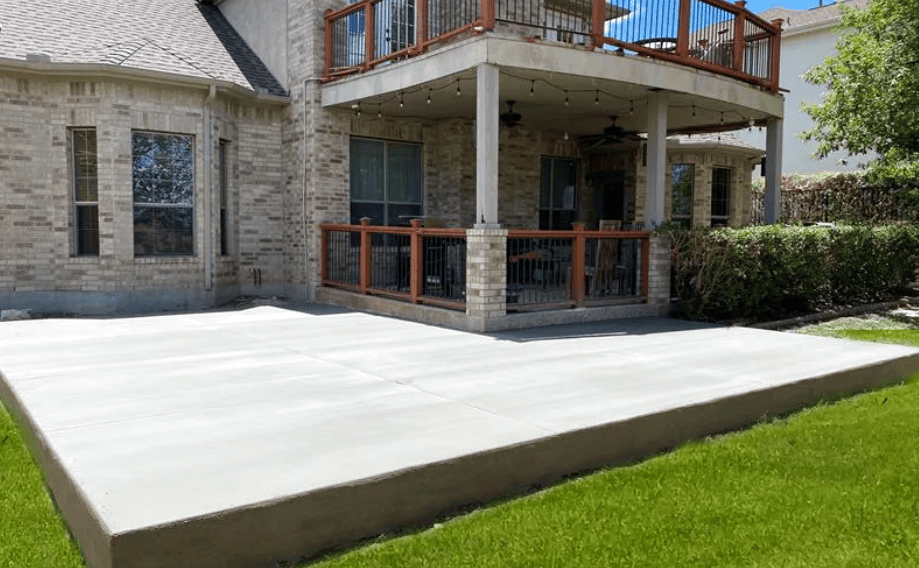
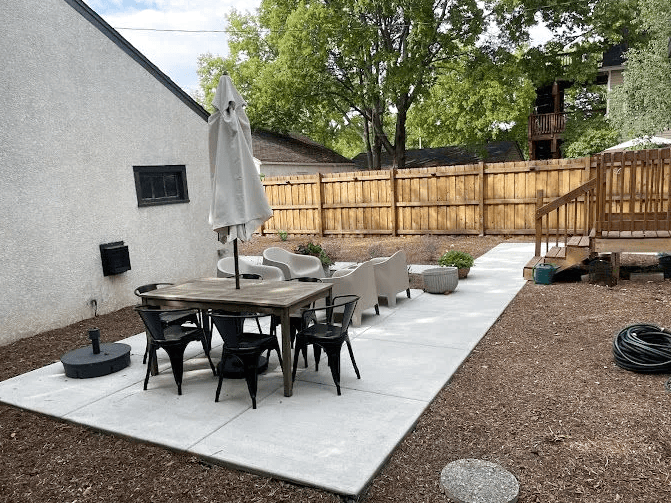
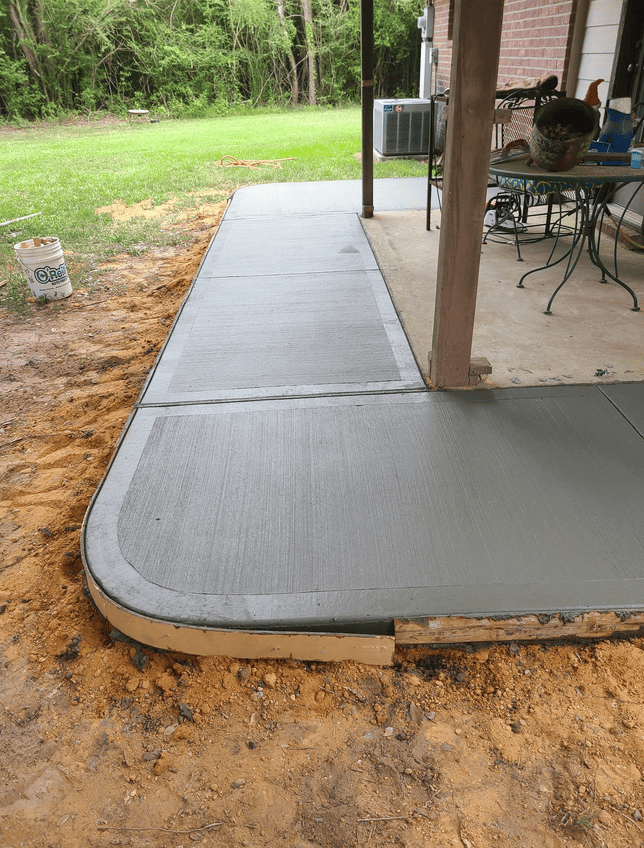
A broom finish is the most common finish we pour for homeowners across West Mobile, Spring Hill, and Tillmans Corner. While the pour is still fresh, we drag a stiff brush across the surface in straight, even lines. This leaves a lightly textured surface that gives you solid traction in wet conditions and cleans up easily with a garden hose. It is a practical, cost-effective choice for most standard patios.
Stamped Concrete Patios
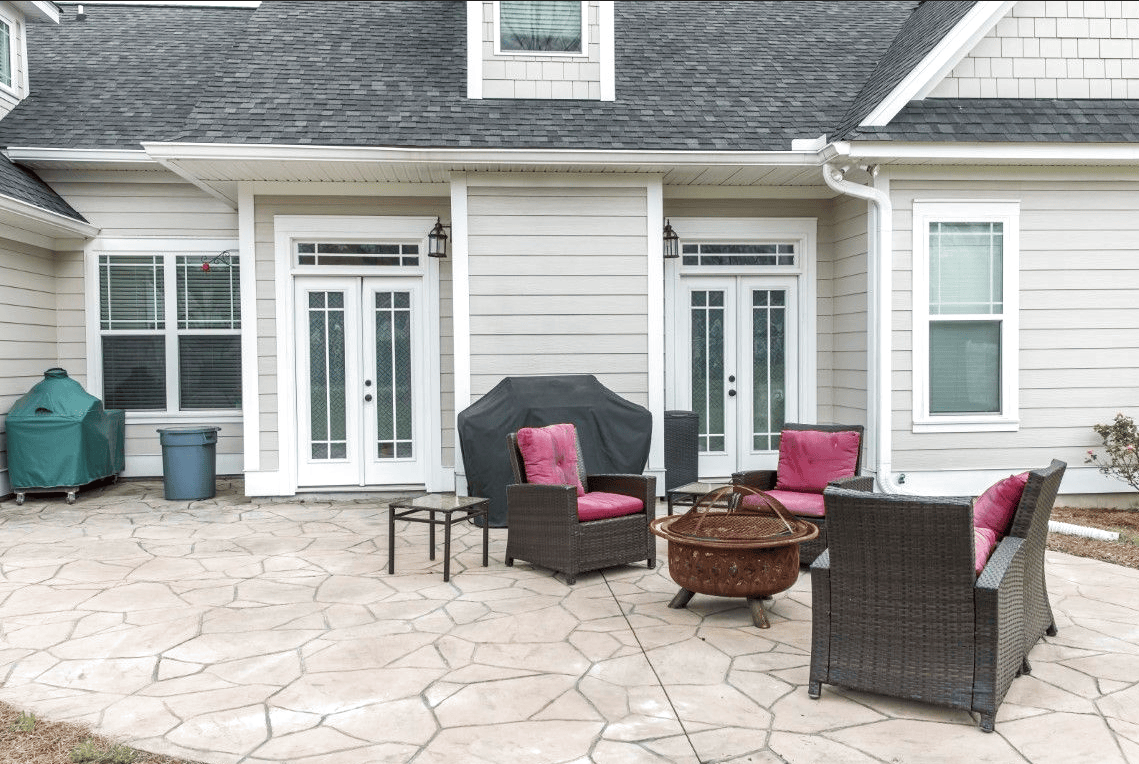
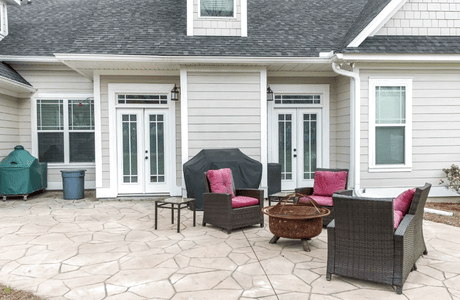
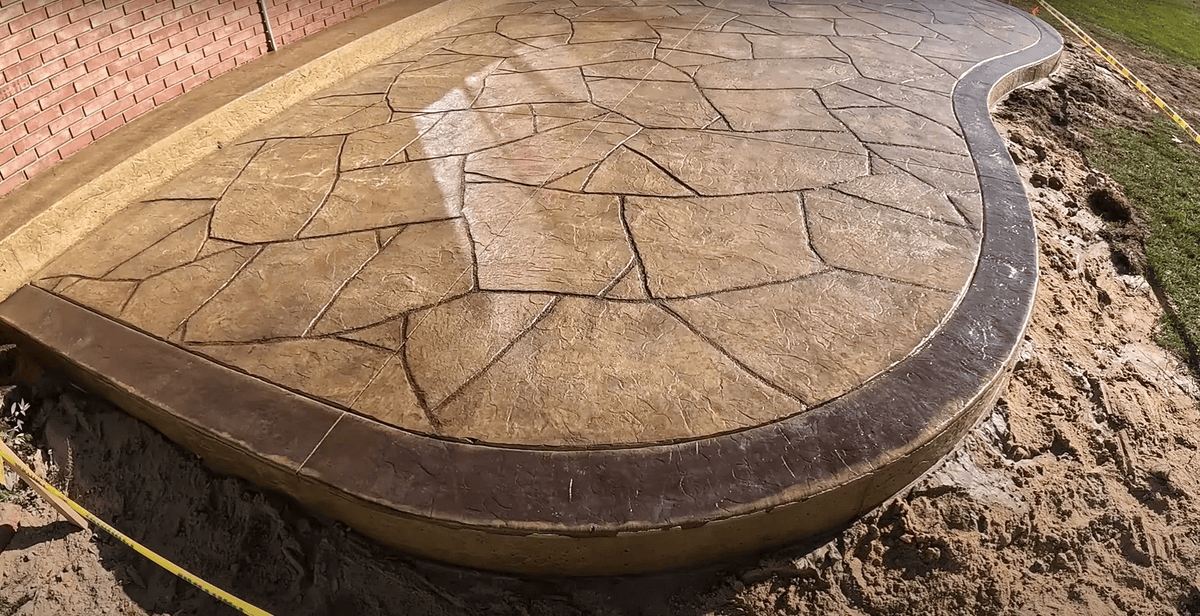
A stamped concrete patio uses rubber molds pressed into the surface before it sets. We can recreate the look of brick, slate, flagstone, wood planks, and more. Homeowners in neighborhoods like Heron Lakes and Cottage Hill often choose stamped work to add visual interest to their outdoor living spaces without the higher maintenance that comes with natural stone or pavers. We use products from Brickform and other trusted suppliers to get clean, consistent impressions every time.
Stained and Colored Concrete Patios
If you want more personality in your patio, concrete patio colors give you a lot of flexibility. Acid stains react chemically with the surface to create earthy, marbled tones that look nothing like painted concrete. Water-based stains and integral pigments give you a wider range of colors with more consistent results. We often combine staining with stamping to deepen the look of a concrete patio design. The color becomes part of the slab, so it does not peel or chip the way a surface coating would.
Exposed Aggregate Concrete Patios
With exposed aggregate, we seed decorative stone or use a mix that already contains coarse aggregate, then wash away the top layer of cement paste before it fully cures. What you get is a natural, pebbly texture with visible stone throughout. It is one of the more durable decorative concrete finishes we offer and works especially well around Dog River and Fowl River properties where the natural aesthetic fits the surroundings. It also provides built-in slip resistance.
Polished Concrete Patios
Polished concrete is less common outdoors in Mobile because our afternoon rains can make a high-gloss surface slippery when wet. That said, it works well for covered patios, screened porches, and outdoor kitchens where direct rain exposure is limited. We grind and refine the surface in passes, finish with a sodium silicate densifier, and seal it to bring up a smooth, reflective surface. It is easy to clean and pairs well with modern outdoor concrete flooring setups.
Slip-Resistant Surface Options for Pool Areas and Wet Conditions
Around pools and in areas that stay wet, surface texture is not optional. We use broom finishes with heavier texture, exposed aggregate, or broadcast non-slip aggregate into a fresh sealer coat to give you reliable footing. When we apply patio sealing solutions in these areas, we use a silane-siloxane sealer or an acrylic cure-and-seal with added grit rather than a smooth-film sealer. This keeps the surface protected without making it dangerously slick.
Every finish we offer starts with the same careful base preparation and quality mix design. The finish is the last step, but what goes underneath is what makes it last. That is a good lead-in to understanding the materials and construction choices that go into a patio built to survive Mobile's climate long-term.
A few years back, we took on a concrete patio job for a homeowner over in west Mobile, near the Tillmans Corner area. It seemed like a straightforward project at first, but it turned into one of the more memorable jobs we have handled in our years of working here in Mobile.
The homeowner wanted a large patio poured off the back of their house, about 600 square feet. We got everything set up, the forms were in place, and we had our concrete truck on the way. Then the weather did what Mobile weather does best. A heavy rainstorm rolled in from the Gulf with almost no warning, right as we were mid-pour.
Pouring concrete in the rain is a serious problem. Too much water mixing into fresh concrete weakens it and ruins the finish. We had to think fast. Part of the slab was already poured and we could not just leave it sitting there. Our crew jumped into action, covering what we had already poured with plastic sheeting while we worked to protect the forms and the rest of the area.
We made the call to pause, let the storm pass, and then carefully assess what we had. Fortunately, because we moved quickly, the section we had already poured was protected well enough to continue. We matched up the new pour carefully so the finished slab came out level and consistent all the way across.
That job taught us a lot about working in Mobile's unpredictable coastal climate. When you hire us for your concrete patio, you get a crew that has dealt with real challenges and knows how to handle them without cutting corners on your finished product.
Concrete Patio Materials and Construction Choices
When you start planning a concrete patio, the finish and design get most of the attention. That makes sense. But the choices made before and during the pour are what determine how well your patio holds up over time. Here is a straightforward look at the materials and construction decisions that matter most for residential patios in Mobile.
Concrete Thickness Options and What We Recommend for Residential Patios
For most residential patios, we pour at a 4 inch slab thickness. That is enough for foot traffic, patio furniture, and grills. If you plan to park a vehicle on the slab or expect heavier loads, we step up to a 6 inch slab thickness. Thicker concrete costs more upfront, but it gives you a stronger slab and reduces the chance of cracking under pressure. We have seen plenty of thin slabs fail early in this area, and the savings on the front end rarely hold up against the repair costs later.
Rebar Versus Wire Mesh Reinforcement
Both options add tensile strength to concrete, but they are not equal. Wire mesh, specifically 6x6 W2.9xW2.9 WWR, is common on lighter residential slabs. It helps hold cracks together if they form. For most of the patios we build, we prefer #4 rebar at 18 inch OC because it provides better load distribution and more reliable performance, especially on ground that shifts or settles. Mobile's expansive clay soils and areas with Mobile Bay alluvial deposits can move seasonally, and rebar holds up better under that kind of stress. We also use fiber mesh reinforcement as a secondary measure to reduce surface cracking during curing.
Base Preparation and Soil Compaction
This step is where a lot of cheap jobs cut corners, and it is usually why those slabs crack or sink. We start by evaluating the subgrade, which in many parts of Mobile means dealing with silty clay, hydric soils, or poorly graded sand. Any soft or organic material gets removed. From there, we bring in a compacted base, typically 12 inch compacted base depth using #57 crushed limestone or a similar clean aggregate, and compact it with a plate compactor to reach the subgrade strength the slab needs. We also lay a 6 mil poly vapor barrier to limit moisture migration up through the slab, which matters a great deal in a coastal climate with a high water table. Skipping base prep is the number one reason patios in Spring Hill, West Mobile, and Tillmans Corner settle within a few years of being poured.
Concrete Mix Options and Additives Suited for Coastal Climates
Not all concrete is mixed the same way. For patios here in Mobile, we typically specify 4000 PSI ready-mix concrete with a water-cement ratio of 0.45 maximum. A lower water-cement ratio means a denser, more durable slab that resists moisture intrusion. We source ready-mix locally from suppliers like CEMEX Mobile or Ready Mix USA Mobile, and we request mixes that meet ASTM C94 standards for consistency. In our coastal environment, we often add Fly Ash Class F as a partial cement replacement. It improves workability, reduces heat of hydration during summer pours, and increases long-term strength. We keep slump at a 4 inch slump maximum to avoid a watery mix that weakens the finished slab. Depending on the project, we may also use a water reducer admixture or a polycarboxylate superplasticizer to maintain workability without adding extra water. After the pour, we apply a curing compound that meets ASTM C309 standards to lock in moisture and allow the concrete to cure properly, which protects against surface crazing and strength loss.
Control Joints and Expansion Joints
Concrete shrinks slightly as it cures, and it expands and contracts with temperature changes. Without a plan for that movement, cracks show up wherever the slab is weakest. We place control joints at roughly 10 foot control joint spacing using a concrete saw at the right time during curing. These joints give the slab a predictable place to crack below the surface, so you do not see random surface fractures running across your patio. Where the patio meets the house foundation or another structure, we install expansion joint filler to allow independent movement between the two surfaces. Getting the timing and layout of these joints right takes experience, and it is one of the details that separates a patio that looks good at five years from one that already needs repairs.
Once the structural foundation of your patio is in place, the next consideration is how water moves across and away from the slab. Mobile gets significant rainfall throughout the year, and without proper slope and drainage planning, even a well-built patio can develop pooling, erosion, or moisture problems at the house foundation.
Drainage, Slope, and Site Grading for Mobile Patios
Mobile gets an average of over 65 inches of rain a year, which puts it among the wettest cities in the country. That kind of rainfall makes drainage one of the most important parts of any concrete patio project here. Before we pour a single yard of concrete, we spend real time studying how water moves across your property.
Why Proper Slope Matters in a High-Rainfall Area Like Mobile
A flat patio sounds simple, but flat surfaces collect water. We build every patio with a 1/4 inch per foot drainage slope away from your home. That gentle pitch moves rainwater off the surface and away from your foundation before it has a chance to pool. In neighborhoods like Spring Hill or West Mobile, where lots can be relatively flat, getting that slope right takes careful planning from the start.
How We Grade and Plan Drainage Before We Pour
We use a laser level to read your existing yard grades before any excavation starts. Mobile's soils are tricky. You'll find expansive clay soil, silty clay, and Mobile Bay alluvial deposits throughout the area, and all of them shift and drain differently. We account for a 12 inch compacted base depth using #57 crushed limestone, which helps water move down and away from the slab rather than sitting beneath it. Where the water table runs high, we plan accordingly so you're not fighting hydrostatic pressure under your patio years from now.
Preventing Ponding and Water Damage Near Your Home's Foundation
Ponding water next to a foundation is one of the faster ways to cause long-term structural problems. We position control joints and plan surface flow so water exits the patio edge in a predictable direction, away from the house. When needed, we work in French drains or channel drains along the patio perimeter to handle heavy downpours. All work is done in line with what the City of Mobile Building Permits Division and Mobile County Engineering Department expect for residential drainage.
Integrating Your Patio with Your Yard's Existing Stormwater Flow
Your patio doesn't exist on its own. It connects to your lawn, your landscaping, and eventually to local drainage systems that feed into waterways like Dog River or Halls Mill Creek. We look at your whole yard, not just the patio footprint, to make sure the finished slab works with your existing stormwater flow instead of fighting it. In some cases, a permeable concrete option can help reduce runoff by allowing water to pass through the slab itself, which is worth discussing if your lot has limited drainage outlets.
Getting drainage right from the start also protects the concrete itself. Water that sits on or under a slab speeds up surface wear, encourages cracking, and can work its way under the edges over time. When those problems show up, the conversation shifts from installation to something else entirely.
Concrete Patio Repair, Resurfacing, and Replacement
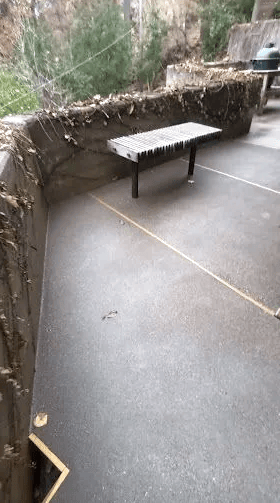
Not every damaged patio needs to be torn out and started over. After more than 20 years of pouring and repairing concrete across Mobile, we have learned how to read a slab and figure out the most practical path forward. Whether your patio has a few surface cracks or it is sinking toward the house, we can walk you through your options honestly.
Signs Your Patio Needs Repair Versus Full Replacement
Some damage is surface-level and easy to address. Hairline cracks, minor spalling, or a dull, worn finish usually point toward repair or resurfacing. But when you start seeing cracks wider than a quarter inch, sections that have shifted up or down, or areas where water pools near your foundation, that often signals a deeper problem. Mobile's expansive clay soils and high water table put real stress on slabs over time, especially in neighborhoods like West Mobile and Tillmans Corner where the subgrade stays wet for long stretches after heavy rain. If the base underneath your slab has shifted or eroded, patching the surface will not hold for long.
How We Fix Cracked and Settling Concrete Patios
For cracks that go through the slab but the base is still stable, we clean out the joint, apply a concrete bonding adhesive, and fill it with a material matched to the existing slab. For sections that have settled, we assess whether the subgrade can be stabilized before deciding on the next step. We use a laser level to check slope and confirm water is still draining at the correct 1/4 inch per foot grade away from your home. Skipping that check is how settling patios end up causing moisture problems along a foundation.
Concrete Resurfacing as a Cost-Saving Option
If your slab is structurally sound but looks rough, a stamped concrete overlay or decorative resurfacing coat can bring it back at a fraction of replacement cost. This is also a good time to revisit concrete patio design choices. You can add texture, change the color, or apply a finish that blends better with updated outdoor living spaces. Products need to bond properly, so surface prep matters a great deal here. We acid-wash and profile the existing concrete before anything goes down so the overlay does not peel or flake later in Mobile's heat and humidity.
When a Full Tear-Out and Repour Is the Right Call
Sometimes the honest answer is that repair money is better spent on a fresh start. If the slab is cracked in multiple directions, has heaved from tree roots, or was originally poured too thin without proper reinforcement, resurfacing is just covering up a problem. We see this often when patios were poured without #4 rebar at 18 inch OC or a compacted base, which is unfortunately common with low-bid work. A full replacement lets us correct the subgrade, set proper control joints, and pour to the right spec from the beginning. Once the new slab is down and cured correctly, it sets you up well for the next step: protecting and finishing the surface with the right sealers and coatings for Mobile's coastal climate.
Sealing, Staining, and Protective Coatings
Why Sealing Matters in Mobile's Coastal Environment
Mobile sits close to Mobile Bay, and that proximity means your patio faces salt air, high humidity, and heavy rainfall year-round. Without a proper sealer, concrete absorbs moisture, which leads to surface spalling, staining from organic debris, and gradual breakdown of the paste that holds everything together. We see a lot of patios in areas like West Mobile and Spring Hill that were never sealed after installation, and they show their age fast. A good sealer is one of the simplest things you can do to extend the life of your slab.
Types of Sealers We Use and How Long They Last
We typically work with a few proven options depending on your surface and goals. A Concrete Sealer Silane-Siloxane penetrates deep into the slab and repels water without changing the look of the surface. It works well on broom-finished and exposed aggregate slabs. For stamped concrete patios or decorative concrete finishes, an Acrylic Cure and Seal brings out color and adds a low-sheen protective layer. We also use a Sodium Silicate Densifier on slabs that need added hardness before a topcoat goes on. Most penetrating sealers last three to five years here in Mobile. Film-forming acrylics typically need attention every two to three years given our sun and rain exposure.
Staining Options to Add Color and Character After the Pour
If you want to add some personality to your patio, staining is a cost-effective path. Concrete patio colors range from earthy tones like slate and sandstone to deeper charcoals and reds. Acid staining reacts with the minerals in the concrete to create natural-looking, mottled tones that are unique to each slab. Water-based stains give you more predictable, consistent color. Both options work well on new slabs and on resurfaced patios. We can also combine staining with a stamped concrete patio layout to get the look of stone or brick while keeping maintenance simpler than pavers. Once stained, a compatible topcoat sealer goes over the surface to lock the color in and protect it from foot traffic and UV fading.
How Often You Should Reseal Your Patio in Mobile
A good rule of thumb for maintenance for concrete patios in this area is to plan on resealing every two to three years for film-forming sealers and every four to five years for penetrating types. You can do a simple water-bead test to check: pour a small amount of water on the slab, and if it soaks in rather than beads up, it is time to reseal. Before we apply any new coat, we clean the surface thoroughly and check for cracks or surface wear that should be addressed first. Skipping reseal cycles in a coastal climate like ours allows salt and moisture to work into the slab gradually, which causes problems that are harder and more expensive to fix later. Keeping up with patio sealing solutions on a regular schedule is one of the most practical things you can do to protect your investment.
Sealing and protective coatings give your patio a strong layer of defense under normal conditions, but Mobile also throws bigger challenges at outdoor surfaces. Hurricanes, flooding, and extreme weather are a real part of life here, and the way your patio is built and finished plays a direct role in how well it survives those events.
Hurricane, Flood, and Weather Resilience
How Concrete Patios Perform During and After Gulf Coast Storms
Living near Mobile Bay means your patio has to hold up against more than just heat. Tropical storms, heavy rain, and the occasional hurricane put real stress on outdoor surfaces. Compared to wood decking or pavers, a properly installed concrete patio handles that stress well. It won't rot, warp, or scatter across your yard in high winds. That said, performance depends heavily on how the slab was built. A thin pour over poorly prepared ground will crack and heave when soils shift after a flood. A slab built with the right thickness, reinforcement, and drainage slope will come through most storms in solid shape.
Building Practices We Follow to Reduce Storm-Related Damage
We've worked in this area for over 10 years, and we know Mobile's soils well. Many parts of the city sit on expansive clay soil or Mobile Bay alluvial deposits that move when they get wet. We address that before we ever pour. We compact the subbase to a reliable depth, typically using #57 crushed limestone as a base layer, and we set the slab to drain at a 1/4 inch per foot slope so water moves away from your foundation instead of pooling. We use 4000 PSI ready-mix concrete for patios that need extra durability, and we reinforce the slab with either wire mesh or #4 rebar at 18 inch on center depending on the load and site conditions. We also apply a quality concrete sealer after the slab cures, which helps protect against moisture intrusion from heavy Gulf Coast rainfall. Control joints are cut at planned intervals so that if minor movement does occur, it happens where we expect it and not randomly across the surface.
What to Do If Your Patio Shifts or Cracks After a Flood Event
After a major storm or flood, it's worth walking your patio and looking for signs of settling, heaving, or new cracks. Small hairline cracks don't always mean serious structural damage, but cracks that are wide, uneven in height, or growing over time usually point to a deeper issue with the subbase. If you're in areas like West Mobile or Tillmans Corner where the water table can run high, subsurface movement after heavy rain is not uncommon. We can come out, assess what happened, and tell you honestly whether the slab needs resurfacing, partial replacement, or a full re-pour with better subgrade preparation underneath. Either way, we'll give you a written scope of work so you know exactly what we're doing and why.
Once your patio is storm-ready and built to last, the next natural step is thinking about how you want to use that space day to day.
Outdoor Living and Patio Add-Ons
A concrete patio can do a lot more than give you a place to set out a few chairs. Many homeowners in Spring Hill, West Mobile, and Cottage Hill are turning their patios into full outdoor living spaces that handle cooking, gathering, and relaxing. The key is planning those uses before we ever pour a single yard of concrete.
Designing Your Patio to Support an Outdoor Kitchen or Grill Area
If you want an outdoor kitchen or a dedicated grill station, the slab underneath it needs to be built for that load. We typically recommend a 6 inch slab thickness under heavy cooking setups, along with #4 rebar at 18 inch OC to handle the added weight. We also factor in the heat concrete sees near grills and fire features, which affects how we approach finishing and sealing. A Concrete Sealer Silane-Siloxane product works well in this area because it resists both moisture and surface staining from grease and ash. Drainage slope matters here too. We pour to a 1/4 inch per foot drainage slope so water and grease runoff moves away from the structure, not toward it.
Adding a Pergola, Fire Pit, or Seating Area on a Concrete Base
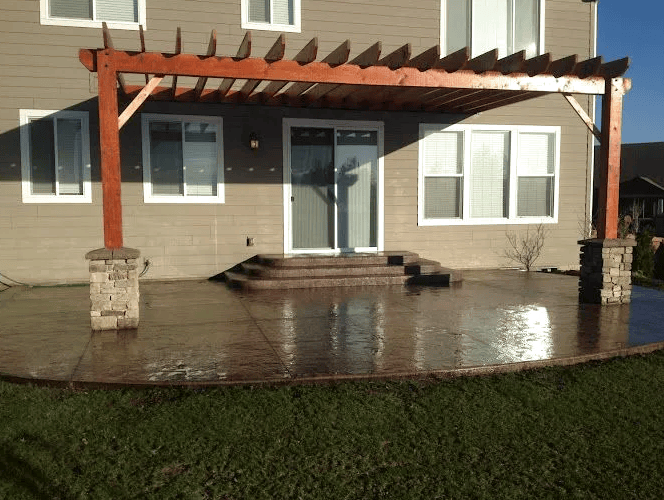
Pergola posts and fire pit footings need anchor points that go beyond a standard residential slab. We plan those locations ahead of time and either embed anchor hardware during the pour or core the slab afterward for post bases. For seating zones, decorative concrete finishes like a stamped concrete patio pattern or exposed aggregate give the area a finished look that holds up to foot traffic and outdoor furniture. We source stamped overlay materials through suppliers like Brickform and finish them with an acrylic cure and seal product to protect color and texture from Mobile's humidity and UV exposure.
Connecting Your Patio to a Pool Deck or Existing Concrete Surfaces
Tying a new patio into an existing pool deck or walkway is common, and doing it right takes more than just matching the color. We use a Concrete Bonding Adhesive at connection points and install expansion joint filler between old and new concrete to allow for independent movement. Mobile Bay Alluvial Deposits and our local clay soils shift seasonally, so giving each section room to move prevents cracking at the joint. We also match slope direction carefully so water from the new slab does not drain onto the old surface and cause pooling near the pool edge or back toward the house foundation.
When we sit down with you to plan any of these add-ons, we build them into the original scope of work rather than treating them as afterthoughts. That includes thinking through utility lines, drainage paths, and load points before the concrete truck from CEMEX Mobile or Ready Mix USA Mobile ever pulls up. Getting the layout right from the start keeps the project on schedule and saves money down the road. Before any work begins, though, we need to walk through what permits and local codes apply to your specific project in Mobile, which is where things can get more detailed than most homeowners expect.
Permits, Local Codes, and HOA Requirements in Mobile
Before we pour a single yard of concrete, we make sure your project is set up correctly from a legal and community standpoint. In Mobile, that means understanding what the City of Mobile Building Permits Division and the Mobile County Building Department require, and whether your neighborhood has its own set of rules on top of that. Skipping this step can lead to fines, required tear-outs, or problems when you go to sell your home.
When a permit is required for a concrete patio in Mobile, AL
Not every patio job requires a permit, but many do. In general, the City of Mobile Planning and Zoning Department requires a permit when a patio is attached to the structure of your home, exceeds a certain square footage, or involves grading changes that could affect drainage toward neighboring properties or nearby waterways like Dog River or Halls Mill Creek. Patios built in flood-prone areas, which covers a fair portion of Mobile given the high water table and proximity to Mobile Bay, may also trigger additional review. We look at your specific lot, your address, and the scope of work before we give you a clear answer on what is needed.
How we handle the permitting process for you
We manage the permit application on your behalf. That includes preparing the required site plan, documenting the proposed concrete patio installation scope, and submitting everything to the appropriate office. Our Alabama Contractor License and Mobile County Business License are on file, which makes the submission process straightforward. We also coordinate any required inspections so you do not have to chase down inspectors or wonder where things stand. Once the permit is issued and the work passes inspection, you get documentation to keep for your records.
HOA rules and how to get your project approved
If you live in a subdivision like Stone Creek, Heron Lakes, or Carriage Hills, your HOA likely has its own approval process that runs separately from city or county permits. HOA rules can cover things like patio size, finish type, color, and how close the slab can sit to your property line. We have worked with HOA boards throughout West Mobile and Spring Hill, so we know how to put together a clear submittal package that gives your board what they need to say yes. We can provide drawings, material specs, and concrete patio design details in whatever format your HOA requires. Getting HOA approval before we break ground protects you and keeps the project on schedule.
Once permits are in hand and any HOA approvals are secured, the focus shifts entirely to finding the right contractor to carry the work across the finish line.
Hiring a Concrete Patio Contractor in Mobile, AL
Finding the right contractor for your concrete patio installation in Mobile takes a little homework, but it is worth the effort. The right crew will know the local soils, the permit process, and how to build something that holds up through years of Gulf Coast heat and humidity. We have been working in this area for over 10 years and have seen firsthand how shortcuts during installation lead to cracked slabs, poor drainage, and costly repairs down the road.
What to Look for in a Local Concrete Contractor
Start by looking for contractors who work specifically with concrete rather than general handymen who pour slabs on the side. A focused concrete crew will have the right equipment, such as a vibratory screed, power trowel, and laser level, and will understand how to properly prepare the subgrade before a single yard of concrete is placed. Mobile sits on a mix of expansive clay soil and coastal plain sediments that behave differently than what you find inland. A contractor who has not worked here may not account for that, and the result is a patio that shifts or cracks within a few seasons.
Look for someone who carries an Alabama Contractor License and a Mobile County Business License. Certifications like ACI Flatwork Technician show that the crew understands proper concrete placement, finishing, and curing standards. These are not just pieces of paper. They reflect real training that translates into better work on your patio.
You should also ask whether they use quality materials sourced locally. Suppliers like CEMEX Mobile and Ready Mix USA Mobile provide consistent ready-mix concrete that meets ASTM C94 standards. A contractor who knows their suppliers and can specify things like a 4000 PSI mix with a water-cement ratio of 0.45 maximum is giving you a slab built to last, not just built to look good on pour day.
Questions to Ask Before You Sign Anything
Before you commit to any contractor, ask these questions directly:
Do you pull permits through the City of Mobile Building Permits Division, or do you expect me to handle that? A reliable contractor handles permitting as part of the job. Do you carry general liability insurance and workers compensation? Ask for certificates, not just a verbal yes. What is your concrete mix design, and what slab thickness do you recommend for my site? For most residential patios in Mobile, a 4 inch slab thickness is standard, though a 6 inch slab may be appropriate if you plan to use the space for heavier loads. What reinforcement will you use? Options include #4 rebar at 18 inch OC or 6x6 W2.9xW2.9 wire mesh reinforcement, depending on your soil conditions and load requirements.
Also ask how they handle drainage. A properly graded patio should slope at least 1/4 inch per foot away from your home. In neighborhoods like Spring Hill or West Mobile where yards drain toward low-lying areas near Dog River or Fowl River, getting the slope right is especially important. Ask for a written scope of work that spells out the mix, thickness, reinforcement, control joint spacing, finish type, and sealing plan before you agree to anything.
Why Licensing, Insurance, and Local Experience Matter
An unlicensed contractor may offer a lower price, but that savings can disappear quickly if something goes wrong. Without proper licensing, work may not pass inspection with the Mobile County Building Department, which means you could be stuck with a patio that does not meet local code. Without insurance, you could be held responsible for injuries that happen on your property during the job.
Local experience matters just as much. Mobile's high water table and hydric soils make subgrade preparation more involved than in drier parts of the state. A contractor who has worked across West Mobile, Midtown Mobile, and communities along Cottage Hill Road understands how moisture moves through the ground here. That knowledge shapes decisions about base depth, vapor barrier placement, and whether a 6 mil poly vapor barrier is needed under the slab. These are details that a crew without local roots may simply overlook.
We carry the proper licensing, insurance, and have spent over a decade working with the soil conditions and drainage patterns specific to Mobile County. That background is not just a credential. It shows up in how we plan and execute every pour.
How to Read Reviews and Check References in the Mobile Area
Online reviews are a starting point, but they are not the whole picture. Look for reviews that mention specific details, like how the crew handled drainage, whether the patio held up after a heavy rain, or how the contractor communicated during the project. Vague five-star reviews with no detail are less useful than a three-sentence review describing real results.
Ask contractors for references from jobs they have completed in Mobile neighborhoods you recognize, whether that is Oakleigh Garden District, Tillmans Corner, or subdivisions like Cottage Hill or Azalea Estates. A contractor with a solid track record in the area will not hesitate to share past customer contacts. When you call a reference, ask specifically about how the finished patio has held up over time, not just how the crew behaved on the job. A patio that looks great the day it is poured but develops cracks or pooling water within a year tells you something important about the quality of the work underneath.
Once you feel confident in a contractor's credentials, local experience, and reputation, the next natural step is understanding what the project will actually cost. Pricing for concrete patio work in Mobile varies based on size, finish type, site conditions, and materials, and knowing what drives those numbers will help you evaluate any quote you receive.
Concrete Patio Cost in Mobile, AL
Understanding what goes into the cost of a concrete patio helps you plan your budget and avoid surprises. We've been working in Mobile for over 10 years, and we know that pricing here isn't the same as what you'd see in other parts of the state. Soil conditions, weather, and local material costs all play a role. Below, we break down the main factors that affect price, what you can expect to pay, and how we handle quotes, payment, and financing.
What Factors Affect the Price of a Concrete Patio
Several things drive the cost of concrete patios in the Mobile area. The size of the slab is the most obvious one, but it's far from the only one.
Soil is a big factor here. Much of Mobile sits on expansive clay soil, Mobile Bay alluvial deposits, and hydric soils with a high water table. That means we often need a deeper prepared base to keep the slab stable. A 12 inch compacted base depth using #57 crushed limestone or Class 1 subbase fill is common on many of our jobs, especially in West Mobile, Tillmans Corner, and low-lying areas near Dog River or Fowl River. Skipping this step is one of the main reasons patios crack and settle early.
Slab thickness also matters. A standard residential patio is usually a 4 inch slab thickness, but if you plan to park a vehicle on it or use heavy outdoor furniture and equipment, we may recommend a 6 inch slab thickness with #4 rebar at 18 inch OC or 6x6 W2.9xW2.9 wire mesh reinforcement for added strength.
Finish type is another major cost variable. A basic broom finish concrete pour costs less than decorative concrete finishes like a stamped concrete patio, exposed aggregate concrete, or a stained slab. These upgraded options require more labor, specialized tools, and additional materials like color hardeners or release agents from suppliers such as Brickform or Euclid Chemical.
Other cost factors include site access, tree root removal, existing concrete demolition, drainage corrections to meet a proper 1/4 inch per foot drainage slope, and whether a concrete pump truck is needed to reach tight backyard areas.
Average Cost Ranges for Basic and Upgraded Patio Finishes
In Mobile, a plain broom finish patio using 3000 PSI ready-mix concrete from suppliers like CEMEX Mobile or Ready Mix USA Mobile typically runs between $8 and $12 per square foot installed. That range includes subgrade prep, a compacted base, forming, pouring, finishing, control joints spaced at roughly 10 foot intervals, and a basic cure using an ASTM C309 curing compound.
Upgraded finishes cost more. A stamped concrete patio with concrete patio colors and texture patterns generally runs $15 to $22 per square foot. Exposed aggregate sits in a similar range. If you're comparing concrete patio vs pavers, a professionally installed paver surface in Mobile typically costs more upfront and requires more ongoing maintenance over time.
Sealing adds a small amount to the initial cost but extends the life of your slab considerably in our coastal climate. We apply a concrete sealer silane-siloxane or an acrylic cure and seal product depending on the finish and exposure. This is especially worth it for patios near Mobile Bay or areas that see heavy humidity and occasional flooding.
These ranges are general estimates. Your actual price depends on the specifics of your lot and project, which is why a written quote matters.
How to Get an Accurate Written Quote
We don't do ballpark quotes over the phone. Every property in Mobile is different, and we need to see your site before we can give you a number you can rely on. When we visit, we check the slope of your yard, look at the soil type, measure the area, note any drainage concerns, and ask about how you plan to use the space.
After the site visit, we put together a written proposal that spells out the scope of work in plain language. This includes slab dimensions, thickness, reinforcement type, base preparation, finish choice, control joint layout, sealing, and any drainage or grading work. We also note whether permits are required through the City of Mobile Building Permits Division or Mobile County Building Department, and we handle that process for you.
A written quote protects you. It gives you something to compare if you're getting multiple bids, and it makes sure everyone is on the same page before work starts. We encourage you to ask questions about anything in the proposal before you sign.
Payment Terms and Financing Options We Offer
We typically structure payments in stages. A deposit is collected at contract signing to cover materials, with the balance due upon project completion. For larger jobs, we may split payments into three stages tied to project milestones. We don't ask for full payment upfront, and we don't consider a job done until you've walked the finished slab with us and you're satisfied.
We understand that a new patio is a meaningful investment, and we work with financing options for homeowners who prefer to spread the cost over time. Ask us about current financing arrangements when you reach out for your quote.
Once we've agreed on the scope, price, and payment plan, the next step is getting your project on the calendar. Scheduling in Mobile requires some planning, particularly around our wet season and material lead times, which is something we'll walk you through in the next section.
Timeline and Scheduling Your Patio Project
How Long a Concrete Patio Installation Takes From Start to Finish
Most residential concrete patio jobs in Mobile take between one and three days of active work on site. The exact time depends on the size of the slab, the finish you choose, and how much site prep the ground needs. A simple broom finish patio on a well-graded lot moves faster than a stamped concrete patio with decorative borders or a job that requires regrading clay-heavy soil. We have worked across West Mobile, Spring Hill, and neighborhoods like Cottage Hill and Carriage Hills long enough to know that every yard is a little different. We account for that from day one.
Concrete Cure Times and When You Can Use Your New Patio
Once the concrete is poured and finished, you should plan to stay off it for at least 24 to 48 hours for foot traffic. For furniture, grills, and heavier outdoor use, we recommend waiting a full seven days. Concrete reaches its rated strength, typically 3000 PSI or 4000 PSI at 28 days, which is also when we apply a final coat of silane-siloxane sealer if that is part of your scope. Rushing this window is one of the most common mistakes we see from cut-rate crews, and it leads to surface damage that is hard to fix without a full overlay.
Best Times of Year to Pour Concrete in Mobile
Mobile's heat and humidity affect how concrete sets. Summer pours, especially from June through August, require careful timing. We schedule early morning pours to avoid peak afternoon heat, use hydration stabilizers when needed, and monitor slab temperature closely. Fall and spring are generally the most forgiving seasons for concrete patio installation here. Winter work is doable, but we keep an eye on overnight lows since temperatures below 40 degrees slow the cure and can affect surface strength if the slab is not protected properly.
How to Get on Our Schedule and What to Expect at the Site Visit
Getting started is straightforward. Reach out to us and we will set up a time to walk your property. During the site visit, we look at the existing grade, soil conditions, drainage patterns toward or away from your foundation, and any access issues for a transit mixer truck or concrete pump truck. We take measurements, talk through finish options like exposed aggregate or decorative concrete finishes, and go over any questions you have about permits through the City of Mobile Building Permits Division or HOA requirements. After the visit, we put together a written proposal with a clear scope of work, material specs, and a timeline so you know exactly what to expect before anything is signed. From there, we work with you to find a start date that fits your schedule and ours.
Once your patio is complete, the job is not finished in our eyes. We stand behind our work, leave your yard clean, and make sure you understand what we guarantee before we walk off the site.
Our Warranties, Guarantees, and Site Cleanup
When we finish a concrete patio installation in Mobile, the job is not over when the last truck pulls away. We stand behind our work, we clean up after ourselves, and we stay available if something comes up later. Here is what that looks like in practice.
What Our Workmanship Warranty Covers
We provide a written workmanship warranty on every patio we pour. That document spells out exactly what is covered and for how long, so there is no guessing on your end. Our warranty covers defects that come from how we built the slab, including problems with concrete patio installation quality, base preparation, drainage slope, control joint placement, and finishing.
We follow ACI 301 guidelines and pour to a 4000 PSI 28-day compressive strength on most residential patios. We use #4 rebar at 18 inch OC or 6x6 W2.9xW2.9 WWR wire mesh depending on the load requirements, and we maintain a water-cement ratio of 0.45 maximum to keep the slab dense and durable. When the work is done right from the ground up, warranty claims are rare. But if a covered issue does come up, we come back out and make it right.
What a warranty does not cover is damage from things outside our control, such as tree roots that were not present at the time of the pour, vehicle loads beyond what the slab was designed for, or flooding events tied to Mobile Bay storm surge. We will always be upfront about what falls inside and outside the warranty before you sign anything.
How We Handle Site Cleanup and Yard Restoration After the Job
Concrete work can be messy. A transit mixer truck, a concrete pump truck, and a crew of workers moving through your yard will leave signs behind. We factor cleanup into every job, not as an add-on but as a standard part of what you are paying for.
After the slab is poured and cured, we remove all forms, excess materials, and debris from the site. We grade and lightly restore any lawn or soil areas that were disturbed during grading or equipment access. If we used a skid steer loader to prep the subbase, we will address any ruts or compacted turf areas before we leave. Concrete washout is handled off-site in compliance with local environmental rules, not rinsed into your yard or the nearest storm drain.
Homeowners in areas like Spring Hill or West Mobile often have landscaping or irrigation near the work zone. We pay attention to those details during the job, and we communicate with you if anything needs to be temporarily moved or protected.
What to Do If You Have a Concern After We Finish
If something does not look right after we wrap up, the best first step is to contact us directly. We have been working in Mobile for over 10 years, and our reputation here matters to us. A quick call or message describing what you are seeing is usually all it takes to get the conversation started.
For minor surface questions, like whether a white haze is normal efflorescence or whether a hairline crack at a control joint is expected behavior, we can often answer by phone or with a photo. For anything that looks more serious, we will schedule a site visit and take a look in person.
We keep records of every job, including the mix design, patio sealing solutions applied, slab thickness, and reinforcement used. That documentation helps us diagnose concerns quickly without starting from scratch. If a repair or adjustment falls under the workmanship warranty, we take care of it at no cost to you. If it falls outside the warranty, we give you an honest assessment and a fair quote before doing any additional work.
Knowing your contractor will still pick up the phone after the job is done is a reasonable thing to expect. That kind of follow-through is part of what separates a professional operation from a one-time crew. In the next section, we bring together everything covered here so you can move forward with a clear picture of what building a concrete patio in Mobile involves from start to finish.
Ready to Build a Concrete Patio That Lasts in Mobile, AL
You now know what goes into a concrete patio that holds up in Mobile's heat, humidity, and coastal air. From proper subgrade preparation on our region's expansive clay soils and Mobile Bay alluvial deposits, to the right mix design, reinforcement, drainage slope, and finish, every step matters. When those steps are done right, you get an outdoor space that serves your home for decades.
Why We Are the Right Choice for Your Concrete Patio in Mobile, AL
We have been pouring concrete in Mobile for over 10 years, and our team brings more than 20 years of combined experience to every project. That experience shows up in the details that protect your investment. Here is what you get when you work with us:
- Local knowledge of Mobile soils, drainage patterns, and the high water table that affects neighborhoods from Spring Hill to Tillmans Corner
- Proper subgrade compaction, base aggregate, and 6 mil poly vapor barrier installation that prevents settling and cracking
- Concrete mix designs, including 4000 PSI ready-mix with Water Reducer Admixture Type A, suited to our hot, humid climate
- Correct thickness, reinforcement with #4 rebar at 18 inch OC or 6x6 W2.9xW2.9 WWR, and control joint layout to minimize random cracking
- Accurate drainage slope of 1/4 inch per foot to move water away from your home
- Finish options including stamped concrete patio designs, broom finish, and exposed aggregate concrete that match your home's style
- Sealing with Concrete Sealer Silane-Siloxane or Acrylic Cure and Seal for protection against salt air and UV exposure
- Full compliance with City of Mobile Building Permits Division requirements and local codes
- Licensed, insured, and accountable work that protects you from liability
- Written warranties, documented scope of work, and complete site cleanup when the job is done
- Honest cost of concrete patios broken down clearly, with no surprises at the end
We work throughout Mobile, including West Mobile, the Oakleigh Garden District, Cottage Hill, and surrounding areas. Whether you want a simple broom finish slab or a full outdoor living space with decorative concrete finishes, we bring the same level of care to every pour.
How to Reach Us and Request Your Free Written Estimate
Getting started is simple. We offer a free site visit and a written estimate that spells out exactly what we will do and what it will cost. There are no vague quotes here, just a clear scope of work you can review before you commit to anything.
You can call us directly or fill out the short form below. We will get back to you quickly to schedule a time that works for you. There is no pressure and no obligation. Just an honest conversation about your project and what it will take to do it right.
Call us today or complete the form below to get your free written estimate.
Mobile AL Concrete
202 Congress St
Mobile, AL 36603
Business Hours
| Mon | 7:00 AM – 10:00 PM |
| Tue | 7:00 AM – 10:00 PM |
| Wed | 7:00 AM – 10:00 PM |
| Thu | 7:00 AM – 10:00 PM |
| Fri | 7:00 AM – 10:00 PM |
| Sat | 7:00 AM – 10:00 PM |
| Sun | 7:00 AM – 10:00 PM |